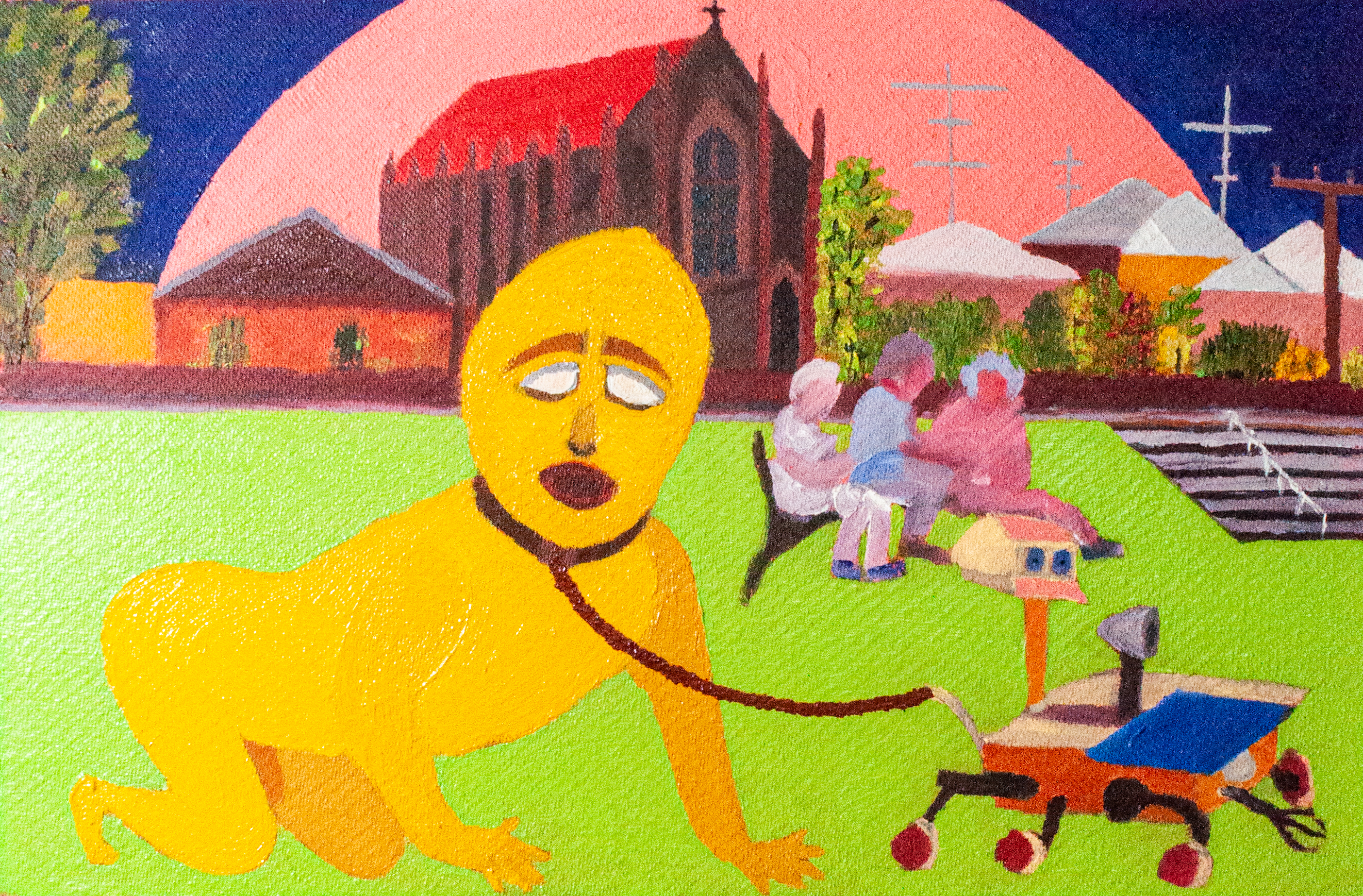
Finally posted after I just found it sitting in Drafts folder!
This post has a few reflections on the feedback I received during the recent Z-Crit and a more detailed examination of the work under consideration:
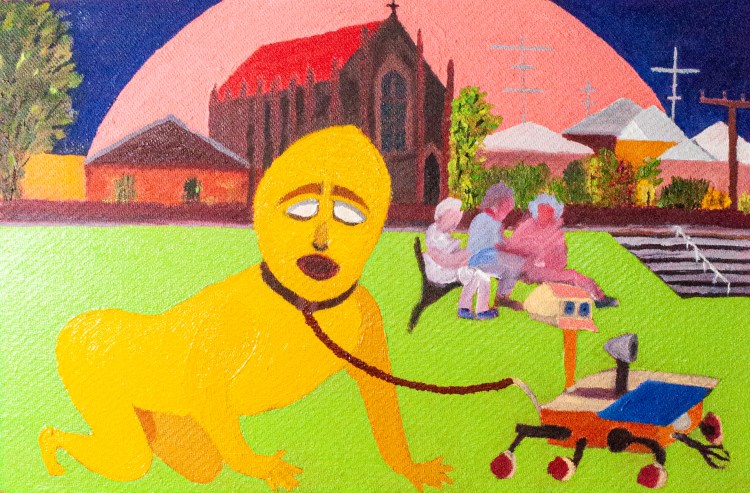
Narrative and Composition
It was clear that the other artists in my crit group found my painting challenging and disturbing. This was not my intent but I would not dispute it. I had tried to make all my paintings slightly surreal – not so much in the hallucinatory or dream-like sense, but more in the sense of magic realism (see also here or here). (Also see Footnote One.)
With my own work, there are at least three main narratives associated with a piece: the one that drives the desire to make something; the one that represents the actual work; and the one(s) which viewers associate with it. Clearly, I’m only in control (or under the influence) of the first two. And a piece will have multiple, evolving narratives, between those two, as it is developed.
The narratives for my Z-Crit painting form part of the discussion of my Foundation course’s FMP final works, but I’ll reiterate it here. All my works on ‘free will and determinism’ for the FMP came from concepts or phrases in Julian Baggini’s ‘Freedom Regained‘. In this case, it was Kant’s idea of the noumenal world: ‘that the world as it appears to us, the world studied by science, is not the ultimate reality’ (Baggini, p22). It is in the realm of the noumenal world that we supposedly find free will. The ‘noumenal self’ uses free will to reason and make decisions which then initiate action in the phenomenal self (i.e. the ‘I’ of the physical world).
I wanted to respond to this nonsensical idea that some thing with no connection to the physical world is somehow in control of it, that there is some non-physical aspect of us that decides how we act. This is the initial, broad-brush narrative.
I had two ideas pretty much from the start: 1) some sort of experiential object (I settled pretty quickly on an instrument-laden Mars rover) dragging around an obviously useless ethereal object; 2) a blind fortune teller trying to ‘read’ a crystal ball. Both these ideas were turned into finished paintings, the first as ‘Phenomenal‘ and the second as ‘Noumenal‘. After initial sketches for ‘Noumenal’ featured an unseeing person representing the noumenal world, I changed the idea for ‘Phenomenal’ to show the rover dragging around an unseeing person to bring the two images together.
The narrative that most of the other artists in the group saw in my piece was a political one (or one of social justice). There was no conscious intent on my part to convey such a narrative. But it doesn’t surprise me that concerns with social justice will show up in my work. I hope that, in the future, I can recognise these indications and do more to make them more explicit.
Subject and Objects
1 
2 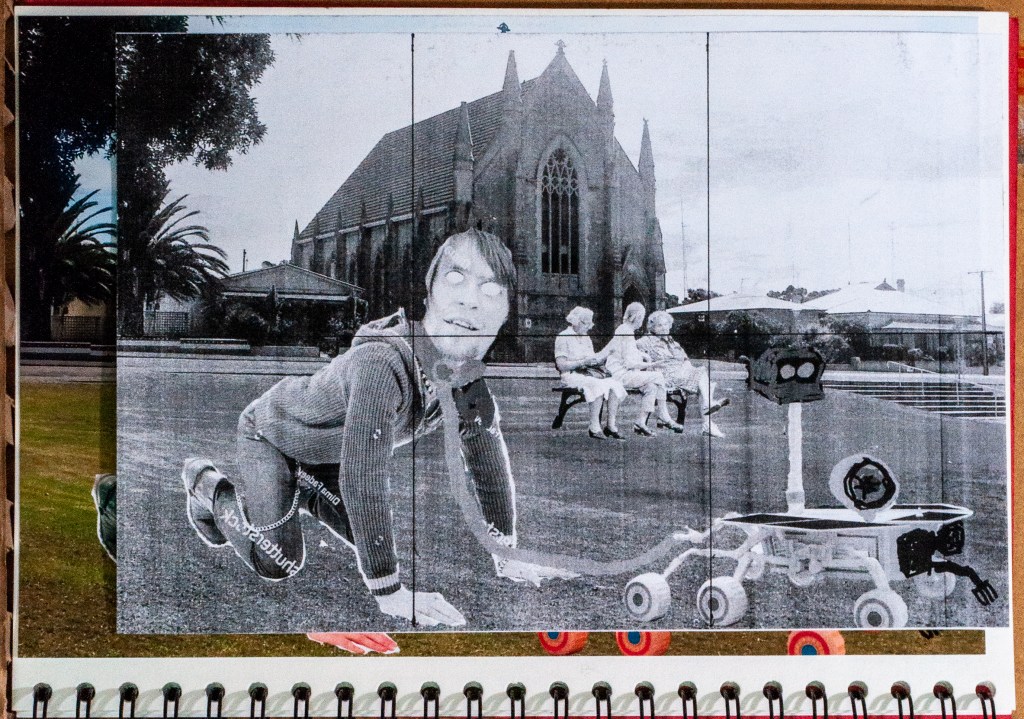
3 
4
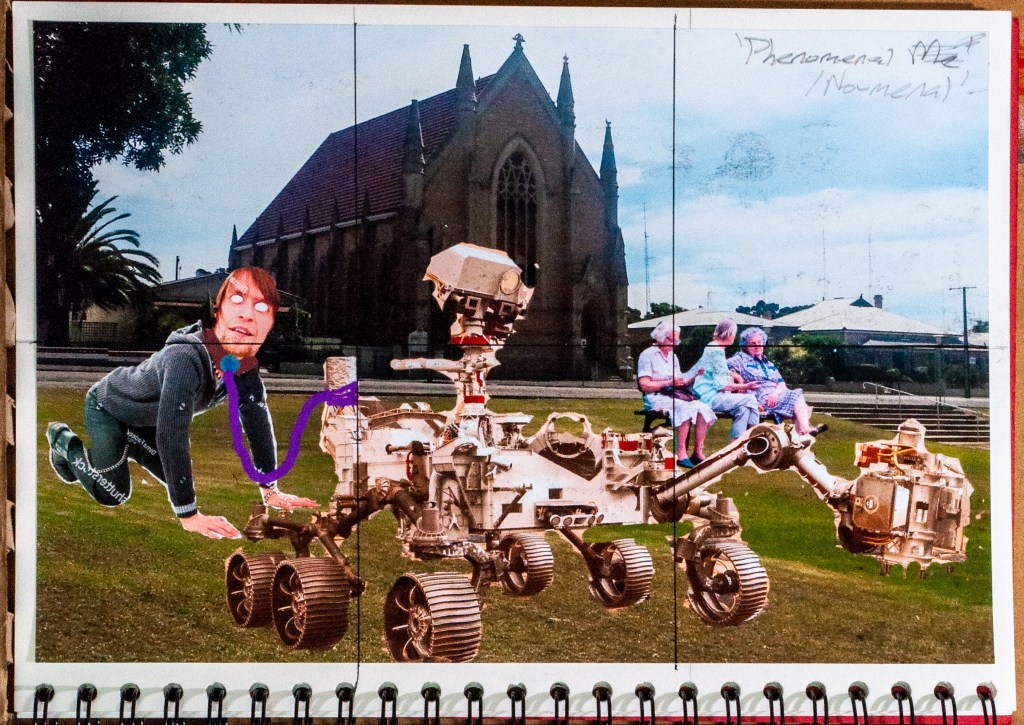
I used Photoshop collages and sketches interchangeably to create a composition. The background image was from a photograph of Queens Square in Moonta, South Australia, that I’d taken a few years ago. It worked for me because of the large green lawns that I could have the rover traversing and the looming church (which stood for another aspect of the idea of some perfect, non-physical, other-world from which rational thought and morality issues).
The old people on the bench were meant to represent a view of the ‘normal’ world that the noumenal world was missing, as well as balancing out the overly surreal aspect of the rover and unseeing person. I think I imported them from another photograph of the same park.
The rover, which represented the phenomenal world because of its multiple devices for sensing the physical world around it, began life in collage and sketch based on the large vehicle planned to lift off for Mars in July 2020 and named Perseverance. As can be seen in the development from collage #1 to sketch #2 above, I wasn’t happy with the rover dominating the image, and made the rover and noumenal person about the same size in the sketch. This still didn’t feel right so I switched to a smaller rover, a mashup of real and imagined devices from different sources, collage #3, and it became even smaller in the sketch, #4.
Even in the final sketch, the noumenal person still retained relatively normal human features but these were left out in the painting: hair and ears are lost while nose is quite rudimentary. The eyes are there to convey blindness while the mouth utters a wordless cry or plaint.
I said above that there was no intent at a political message but the dominance of the church in the background will have had me thinking about thought-policing and the despair and hopelessness that having contrary thoughts can induce. So there is no surprise at the pathetic nature of the ‘noumenal’ figure.
The comment made about the lack of shadows in the picture did surprise me – I hadn’t noticed their absence and nor, it seems, had anyone else. I think I have a strange relationship to shadows. I tend to see them as primary sources of meaning. When doing the initial investigations in a project, I will often use the shadows in photographs to create experimental drawings and patterns, or turn them into strange creatures inhabiting and interacting in some fantasy world. These creatures might or might not make their way into final works. If I were to add shadows to a painting, they would certainly, in my mind at least, carry a significant part of the meaning of the work.
Colour and Application
I think the application of the paint is probably my weakest area: hardly surprising as this was only my third oil painting. Because I am using mainly areas of flat colour, I tend to use brush strokes to indicate shape within a form, such as pushing the paint into a ridge to indicate the arm against the body or dabs of thick paint for the background foliage. I was pleased that one person mentioned these marks. But I have a long way to go before I’m comfortable with, let alone proficient at, applying oil paint.
I’m not sure how to approach the use of colour. Everyone mentioned how the colour choices were striking and a large part of the affect caused by the image. None of the individual colours used were chosen to be symbolic. I tended to choose one colour for the first form to be painted, in this case yellow for the noumenal figure being led around. Other colours then were added to work with or against other colours.
Symbolism, etc
I was pleased that one participant in the crit thought that the person being led around on a rope reminded them of the character, Lucky, in ‘Waiting for Godot’ – I only wish I’d thought of it! It would be quite an apt comparison with the play’s interpretation as a discourse on existential nihilism. What might be more nihilistic than reducing all human rationality and morality to some ethereal netherworld.
Footnotes
One
I’ve been looking at other movements or modes of practice that my work have aspects of, so as to better find artists I might investigate. They include (all examples from Artsy‘s list of categories):
 Tony Linde